Inside a Jacket Lining: What It Does and Where It Shows
Inside a jacket lining, seams, vents and sleeve finishes reveal how the garment is assembled, how it moves and what to inspect before choosing it.
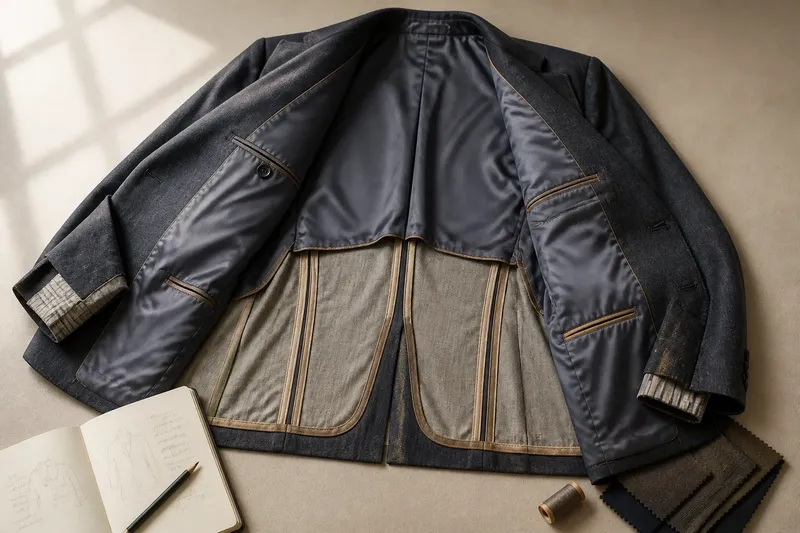
A jacket lining is not simply a hidden layer of fabric. Inside a jacket lining, the seams, openings and sleeve finishes show how the garment is assembled and how its outer shell is meant to move. Turn the jacket inside out and look for these details before judging the interior as tidy or untidy.
1. Separate lining from interlining
The lining is the fabric layer facing the wearer. It covers much of the inside of a jacket, protecting the inner construction from direct contact and giving the garment a finished surface. It may be made from acetate, viscose, polyester, cupro or another fabric; its appearance alone does not tell you how the whole jacket is built.
Interlining is different. It sits between outer fabric and lining in selected areas, helping shape or support parts such as the front panels, collar and lapels. A jacket may also contain a canvas layer, shoulder padding or other internal components. These are construction elements, not extra names for the lining.
Look at the inside edge near a lapel or front opening. The visible lining may stop before the outer shell, leaving the underlying construction concealed. You are seeing a finished surface, not a complete map of every layer beneath it.
2. Check where the lining ends
A fully lined jacket has lining across most of the body interior. In a half-lined or partially lined jacket, some areas are left uncovered, often across the back or lower body. An unlined jacket has no separate lining layer, though its seams may still be bound, overlocked or otherwise finished.
These choices affect the jacket’s interior appearance and how much of its construction you can inspect. An unlined jacket makes seam finishing prominent. A partially lined one offers a view of some inner seams while retaining a smoother surface in other areas. A full lining conceals more of the interior assembly.
Check the back, side seams and hem rather than relying on a product description alone. A lining may cover most of the body but stop above the hem, or it may be cut away around a vent. The precise arrangement is easier to understand when you follow the lining edge around the garment.
3. Follow the seams
Seams join the lining panels and attach the lining to the jacket at particular points. Look for straight, even stitching and allowances that are enclosed or finished neatly. A small amount of puckering can occur where several layers meet, but pronounced pulling may suggest that the lining is under tension or does not sit smoothly.
Pay attention to the seam at the armhole, where the sleeve lining meets the body lining. This is a busy junction: sleeve, body and sometimes shoulder components converge there. A clean finish should not feel like a bulky knot or show loose threads that catch on a hand or cuff.
Also inspect the lining around the inside pocket. The pocket bag is usually attached to the jacket’s inner construction, while the lining provides a finished surround or access opening. The arrangement can differ by design, but the pocket should sit flat when empty and should not drag the front lining out of shape.
4. Find the movement allowance
A jacket lining needs enough ease to move with the wearer without pulling the outer fabric inward. Look for a small fold or pleat at the centre back, often called an ease pleat. It gives the lining room to spread when the shoulders move forward, rather than forcing a flat lining panel to act like a strap.
Some jackets also leave a little extra length in the lining near the hem. That allowance helps the inner layer sit without tugging when the wearer sits or reaches. The lining should not hang so low that it protrudes beneath the jacket, nor should it pull the outer hem into visible ridges.
Say you try on a lined wool jacket and the back lining looks smooth while your arms rest at your sides. When you reach forward to pick up a bag, a slight shift is expected; if the jacket’s back is dragged sharply across the shoulders, check whether the lining is taut and whether the jacket itself fits. The lining can reveal a restriction, but it cannot identify its cause on its own.
5. Inspect vents and hems
At the back, a vent needs room to open without the lining snagging or stretching across it. Look inside the vent area for a neat overlap or pleat that accommodates the opening. Then let the jacket hang naturally: the lining should settle inside rather than spilling through the vent or bunching against it.
At the hem, notice whether the lining is attached continuously or allowed to hang free in places. A free-hanging section can reduce strain as the jacket moves, while a securely finished edge keeps the lining from twisting around the body. Neither arrangement is automatically better; the finish should lie flat and suit the jacket’s construction.
If a vent looks closed when the jacket hangs but opens readily with movement, that can be ordinary. A lining caught in the vent, or an outer panel that stays sharply pulled out of line, deserves closer inspection. Do not tug hard at the layers to diagnose it; the stitching is not a handle.
6. Read the sleeve lining
Sleeve linings help the arm pass into the jacket and move within the sleeve. They are often smoother than the outer cloth, but the hand of the fabric is only one part of the experience. Check that the sleeve lining reaches the cuff neatly and does not twist or bunch inside the sleeve.
At the cuff, look for a clean joining seam and an even lining edge. If the jacket has functional sleeve openings, the construction around them may be more involved than on a decorative cuff. A little lining movement is normal; lining that repeatedly emerges from the cuff suggests that it may be caught, twisted or poorly secured.
Raise and lower your arms gently while wearing the jacket. The sleeve should move without the lining winding around the forearm or pulling the body of the jacket upward. If that happens, compare both sleeves and check the fit at the shoulder before blaming the lining alone.
7. Read the label and finish
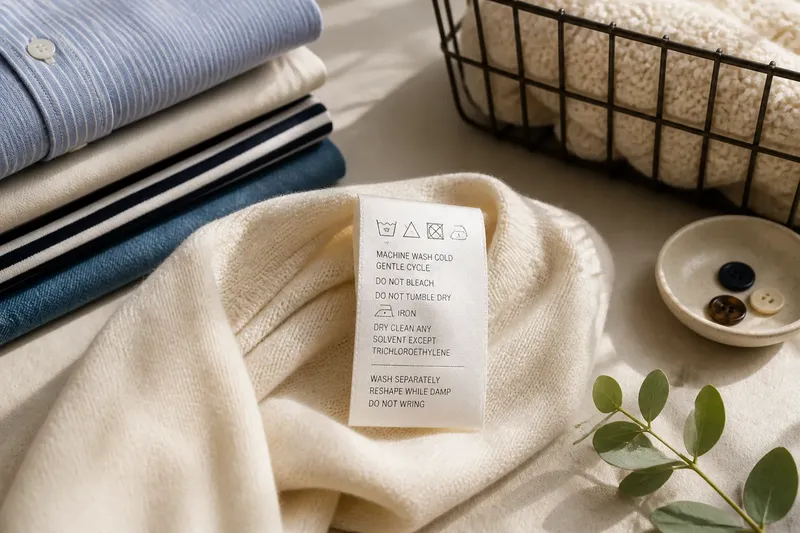
The lining’s fibre content can affect feel, static, breathability and how it responds to care. Read the composition label rather than guessing from sheen or smoothness: several fibres can look much alike. The label and manufacturer’s instructions determine appropriate care, since the lining and outer shell may need different treatment.
Notice the lining’s colour and pattern, too. A contrasting interior can be a deliberate design choice; a discreet one keeps attention on the outer cloth. Neither tells you whether the jacket is well made. More useful clues are whether the lining lies flat, whether its joins are tidy and whether its openings allow the garment to move without obvious strain.
Questions about jacket linings?
Can a jacket be partly lined?
Yes. A partially lined jacket leaves some interior areas uncovered while lining others. Check the back, sides and hem to see exactly where the lining stops.
Should a jacket lining be loose?
It needs enough ease to move, but it should not hang in folds or distort the jacket. A back pleat or a little allowance at the hem can provide movement without looking baggy.
What does a twisted sleeve lining mean?
It may be caught or poorly settled, but sleeve fit and the way the jacket is worn can also affect how it sits. Compare both sleeves and see whether the lining returns to place when the jacket is taken off.
Does a smooth lining mean better quality?
No. Smoothness is a matter of feel, not a reliable verdict on construction. Inspect the seams, attachment points and movement allowance as well.
Use the inside as evidence
Inside a jacket lining, the useful clues are practical: where the layer ends, how seams are finished, whether vents and sleeves move freely, and whether the fabric stays in place. These details help you understand the garment’s construction without treating one neat-looking surface as proof of quality. A brief look inside can answer more than the label’s polished description, provided you judge the whole jacket rather than asking the lining to explain everything.