Linen, Twill and Jersey: Three Different Kinds of Drape
Compare linen, twill and jersey by how each hangs, folds and moves, so you can describe fabric drape clearly and choose cloth for the shape you want.
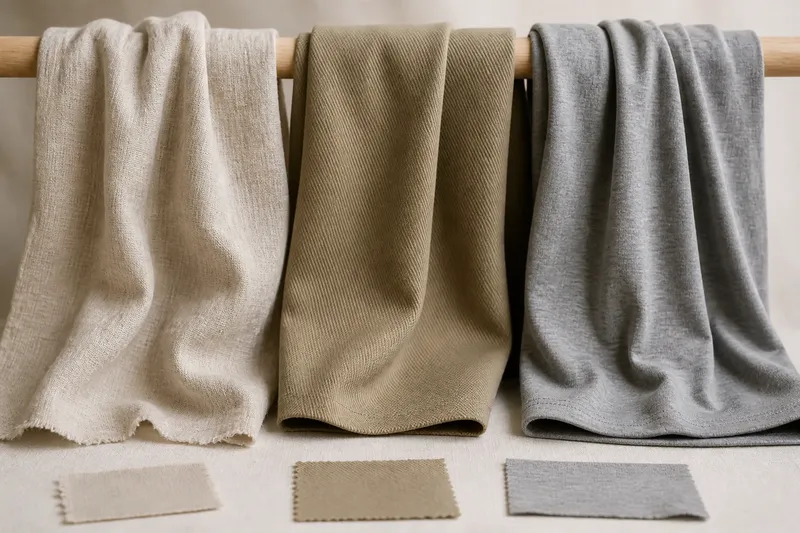
Linen, twill and jersey make different shapes around the body, even when they are cut into similar garments. To compare their drape, begin with how each fabric hangs, then watch its folds and movement; the fibre name alone will not tell you everything.
Drape is the way cloth falls under its own weight and responds to handling. It is not a ranking from stiff to elegant. A fabric that holds a clean line may suit a boxy shirt, while a fabric that follows the body may work better for a close-fitting top. The useful question is what the cloth is doing, not whether it is “good”.
Start with the swatch
Use a fabric swatch if you can. A remnant or an unhemmed garment can also offer clues, though seams and pattern shape affect what you see. For a fair comparison, look at pieces of similar size and hold each by one edge. Do not stretch jersey to match the others; its elasticity is part of its behaviour.
First, note the fabric’s weight and surface. A light cloth may flutter simply because there is little mass to pull it down. A heavier one may form broad, settled folds. These are observations, not conclusions: weave, knit, finishing and fibre all contribute, and “linen”, “twill” and “jersey” do not describe the same kind of feature. Linen names a fibre, twill a weave, and jersey a knit structure.
Next, let the swatch hang freely. Look at the outline below your hand. Does it drop in a narrow column, stand away from the hand, or spread into a soft curve? Then turn the edge and watch how the cloth bends. A sharp fold, a rounded fold and a cluster of small ripples are different signs of drape.
Read linen’s folds
Linen is made from flax fibre, but linen fabrics vary. A fine, light linen can fall softly; a denser, crisp version may keep more shape and make angular folds. Many linen garments have a dry, slightly textured surface that catches light unevenly. The familiar creasing is not a separate drape category. It is one visible result of the fabric bending and settling as it is worn.
When you hold linen by one corner, watch whether the hanging edge stays relatively direct or breaks into small, irregular folds. A crisp cloth often resists a rounded curve at first, then settles into creases. A softer linen may fold more readily and follow the hand. Neither behaviour applies to every linen: yarn, weave, finishing and cloth weight can change the result.
On the body, linen can look airy without clinging. A loose linen shirt may stand slightly away from the torso, then form creases at the elbow and waist as the wearer moves. That gives the garment a visible, lived-in surface. If you want a smooth outline or a fabric that hugs curves, inspect the actual garment rather than relying on the fibre name.
Trace twill’s diagonal
Twill describes a weave in which the threads create a diagonal surface pattern. Denim and many work trousers use twill, but the word does not specify fibre, thickness or softness. A cotton twill can feel firm and hold a defined shape; a lighter, softer twill may bend into fluid folds. The diagonal ribs are a clue to construction, not a promise of a particular hang.
Hold the cloth by an edge and see how readily it forms a long fold. Some twills drop in broad, controlled planes rather than breaking into the fine creases common in crisp linen. Firmer twills may keep a crease or a rounded edge in space. Softer ones can swing and settle more easily. Rub the surface lightly between your fingers: the diagonal texture may be subtle, or pronounced enough to change how light travels across it.
That combination of surface and shape makes twill useful for garments that need a clear outline. A pair of trousers in firm twill can keep a straight leg line, while a softer twill skirt may swing from the hip. The weave alone does not decide which effect you get; the cloth’s weight and finish matter, as does the cut.
Watch jersey move
Jersey is a knitted fabric, commonly made with loops rather than the crossing threads of a woven cloth. It often stretches more readily and recovers to some degree after being pulled, though the amount depends on the yarn and construction. A single jersey T-shirt fabric can curl at its cut edge; a denser knit may feel more stable. These are structural clues, not universal rules for every jersey.
Support a jersey swatch across your hand instead of gripping it tightly. Let the centre sag, then move your hand gently from side to side. The cloth may follow the motion in soft waves and settle close to the hand. If you stretch it while observing, distinguish that temporary extension from its resting drape: a stretched knit can look longer and narrower than it will when worn without tension.
On a body, jersey often follows curves more closely than a comparably weighted woven fabric, especially when a garment is cut close. A loose jersey top can still hang away from the body, and a substantial knit may hold a rounded shape. The knit’s elasticity makes movement part of the picture: it can extend as the wearer bends, then return towards its resting form.
Compare the movement
Once you have looked at the stationary folds, give the cloth a small, consistent motion. Lift the edge and release it, or sway the swatch gently. Notice whether it swings as one broad panel, flutters in small ripples, or stretches and settles. Keep the movement modest; a vigorous shake says more about your wrist than the cloth.
Say you are choosing between a linen shirt, a twill overshirt and a jersey top for a relaxed silhouette. Imagine laying each over a chair back, then lifting it by the shoulder seam. The linen may hold a slightly broken, airy outline, the twill may form a more deliberate panel, and the jersey may sag into a softer curve. That observation helps describe the options, but the cut and fabric versions still need checking in the garment itself.
For a useful comparison, record a few plain-language observations rather than a verdict:
- Outline: Does the cloth hang close to the support or stand away from it?
- Fold shape: Are the folds angular, broad and rounded, or fine and rippled?
- Movement: Does it flutter, swing as a panel, or stretch and settle?
- Surface: Is the texture smooth, dry, ribbed or visibly diagonal?
- Recovery: After gentle handling, does the fabric return towards its original shape?
Use the same words for each swatch. “Soft” can refer to touch, drape or both, so say “soft to the hand” if you mean texture and “falls in rounded folds” if you mean shape. “Fluid” suggests easy movement; “crisp” suggests that the cloth resists bending or holds a defined edge. Specific language makes comparison more useful than calling one fabric simply drapey.
What changes the result?
Fibre, construction and finishing overlap. Linen describes a fibre source; twill identifies a weave; jersey identifies a knit. A fabric can combine these categories: linen yarn may be woven in a twill structure, and a jersey may use different fibres. Therefore, a label may identify only one part of the cloth’s construction.
Weight is another factor. A light twill and a heavy twill can behave quite differently, just as a loose, airy linen differs from a compact one. Finishing can soften, stiffen or smooth the surface. The garment pattern then adds its own influence: pleats gather cloth, darts shape it, and seams restrict how freely a panel falls.
When shopping, handle the actual fabric or inspect a close view of its surface. Check whether the garment is lined or layered, since another layer can change the way it hangs. For online descriptions, look for both the fibre content and the construction terms, but treat words such as “soft” or “fluid” as prompts to verify against photographs or the garment in person.
Which drape suits the shape?
Choose by the outline you want, not by a general claim that one fabric is best. Crisp linen can give a shirt a relaxed but structured shape. A firm twill can support a clean line in trousers or a jacket. Jersey can make a close silhouette comfortable in motion, or fall loosely in a simple top when the cut allows room.
Before buying, ask what the cloth should do at the points that matter: Should a sleeve crease visibly? Should a skirt swing away from the leg? Should a top follow the torso or skim it? Then compare the garment’s fabric, cut and construction together. If the answer depends on the specific cloth, check its label and the maker’s description rather than assuming the material name settles it.
Questions about drape?
Is linen always crisp?
No. Linen can be crisp or soft, depending on the cloth’s weight, weave and finish. Judge the particular fabric by its folds and how readily it bends.
Does twill always feel heavy?
No. Twill names a weave, not a weight. A lightweight twill may fall easily, while a denser one can hold a more definite shape.
Is jersey the same as stretch fabric?
Jersey is a knit structure, and many jerseys stretch, but the degree varies. A knit’s fibre, yarn and construction affect both extension and how it hangs at rest.
How can I describe drape clearly?
Describe what you can observe: how close the cloth hangs, what its folds look like, and how it moves. “A firm twill that holds broad folds” tells a reader more than “nice drape”.
For comparing linen, twill and jersey, keep the distinction between fibre, weave and knit in view, then describe the fabric’s actual behaviour. That gives you a vocabulary for choosing a silhouette without asking one cloth to suit every body, garment or occasion.