The Care-Label Myth: One Symbol Does Not Explain the Whole Garment
Care-label symbols make more sense when read together. Learn how to check each instruction, spot restrictions and choose a suitable method for the whole garment.
A care label can permit washing and still rule out tumble drying. Read every instruction before cleaning a garment, because a wash symbol alone does not settle what happens next. Care-label symbols are useful shorthand, but their precise forms and meanings can depend on the labelling system used for the intended market.
Washing, bleaching, drying, ironing and professional cleaning are separate parts of garment care. Labels may pair symbols with written directions, temperature limits or cautions. Treat them as a set of constraints: one permissive mark does not cancel a restriction elsewhere.
What Labels Explain
A care label gives directions for handling the finished garment, including how it may be cleaned, dried and pressed. It can also indicate that certain treatments should be avoided. The written wording matters alongside the symbols.
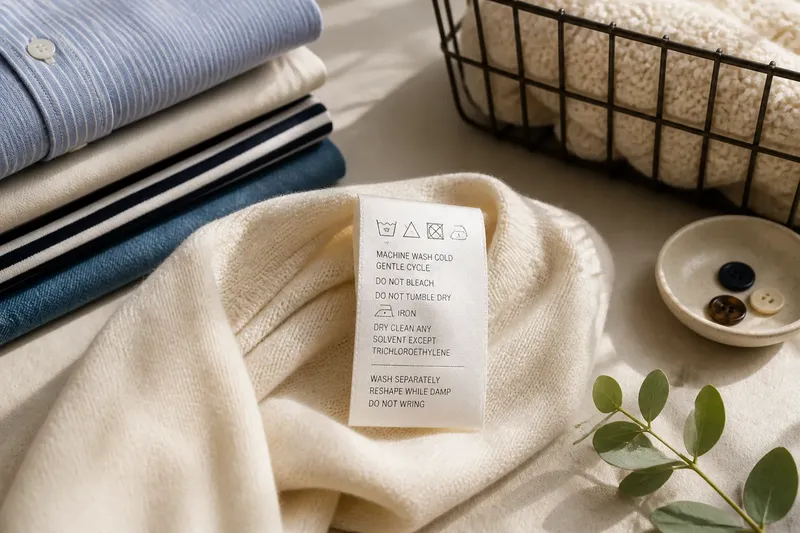
Common symbol families use a tub for washing, a triangle for bleaching, a square for drying, an iron for ironing and a circle for professional cleaning. Details such as crosses, dots, lines or numbers can alter the instruction. Because symbol systems and their presentation may vary by market, check the label’s accompanying wording and use a reliable guide intended for that labelling system if a mark is unfamiliar.
Notes such as “wash separately”, “reshape while damp” or “do not wring” are specific directions, not decorative footnotes. They may address colour transfer, stretching or a construction detail that does not tolerate twisting. If care information appears on several attached tags, read all of them.
Why One Mark Fails
A machine-wash symbol says nothing by itself about tumble drying, ironing or bleaching. It may also leave details of the wash process to other marks or written instructions. The rest of the label fills in those limits.
Imagine a cotton top whose label permits machine washing, prohibits tumble drying and allows ironing only at low heat. The action is to wash it as instructed, let it dry without a tumble dryer and use only the stated iron setting if needed. The observable result is that each stage stays within the label’s stated limits; the cotton content alone does not decide how to treat the finished top.
Labels apply to the whole garment, not just its main fabric. A woven shell may sit alongside a lining, elastic, printed decoration, buttons or delicate trim. A fibre name such as cotton does not override a warning about a bonded panel or embellishment.
Reading Care-Label Symbols
Read the instructions in the order care tasks occur: washing, bleaching, drying, ironing and professional cleaning. For each mark, identify its action, any limit and any prohibition.
- Action: Check which task the symbol covers. If it is a wash symbol, use it to guide washing; if another symbol covers drying or ironing, check that separately.
- Limit: Look for dots, numbers or lines that specify a setting or gentler process. If the detail is unclear, consult a guide for the relevant labelling system; if you cannot identify it, do not guess at a more aggressive treatment.
- Prohibition: Check for a cross through a symbol. If the mark prohibits an action, leave that action out; if another permitted method is clear, use that method instead.
- Written notes: Read phrases such as “wash separately” or “reshape while damp”. If a note adds a handling requirement, follow it; if it conflicts with what you thought a symbol meant, pause and check the full label or ask a cleaner.
- Separate tags: Check whether the garment has more than one care tag. If so, read each one; if a tag appears missing or contradictory, seek clarification before cleaning.
In commonly used systems, a hand in a tub indicates hand washing, while lines beneath a tub indicate a gentler process. A square can show tumble drying or natural drying, and dots in an iron symbol indicate a heat setting. Do not rely on the general shape alone if the mark or its system is uncertain.
Labels can be folded into a side seam. Pull the tag flat and check both sides. If a symbol remains unfamiliar, compare it with a reliable textile-care guide or the brand’s information, making sure the explanation matches the exact mark and intended labelling system.
When Instructions Differ
Follow the garment-specific directions, including the most restrictive instruction for each care stage. If washing is permitted but tumble drying is not, wash as directed and do not use the dryer. Do not choose a convenient mark while ignoring another restriction.
Care information may be split across attached tags, and a replacement label may not describe every detail of an older or altered item. Read the complete set. If the instructions still seem to conflict, ask a professional cleaner to assess the garment rather than trying a treatment by guesswork.
Keep care instructions separate from fibre information. “Wool”, “viscose” and “polyester” describe composition, not a complete cleaning method. Two garments made from the same fibre may have different finishes, linings or construction. The individual garment’s care label takes priority over a rule of thumb based only on fibre.
Can You Wash Dry-Clean Only Items?
Does hand washing replace dry cleaning?
No. Do not assume that hand washing or a gentle machine cycle is an acceptable substitute for a dry-clean-only direction. A structured layer, lining or finish may react differently to water; ask a professional cleaner whether a suitable alternative exists.
Are “dry clean” and “dry clean only” the same?
Do not casually treat the phrases as interchangeable. If the wording is unclear or the item matters to you, ask a cleaner to interpret the label before proceeding.
What if the label is unclear?
Check all attached tags and the brand’s care information, matching the details to the garment. If uncertainty remains, a professional cleaner can assess the fabric, construction and finish.
Can I use a home-care product instead?
A product’s directions do not override the garment’s label. If the proposed treatment is not clearly permitted, check with a qualified cleaner rather than assuming the product is suitable.
Crossed-Out Symbols
A crossed-out symbol indicates that the labelled action is prohibited for that garment. A crossed-out tumble-dryer does not mean “use a cooler setting”; it means do not tumble-dry. Choose another drying method only if the rest of the label permits it.
Do not treat a prohibition as optional because a garment looks sturdy. Damage may not be immediately obvious: elastic can lose resilience, a print can crack or the shape can shift. The label gives handling directions for the finished item; it is not a prediction that every forbidden action will cause visible damage on every occasion.
Drying Without a Dryer
Use the drying method specified on the label. A line-dry direction calls for hanging; a flat-dry direction calls for supporting the garment horizontally. Do not add heat or rough handling that the other instructions do not permit.
For a knitted garment marked to dry flat, lay it on a clean, dry towel and arrange it in its natural shape. Do not hang it wet if the label warns against stretching. For a woven shirt whose label permits line drying, smooth the seams and collar while it is damp, then hang it where air can circulate.
Missing Label Decisions
Without a readable label, fibre content alone cannot supply the missing directions. If you can identify the garment, check the brand’s care information using its style details. If that yields no instructions, a professional cleaner may be able to assess the fabric, construction and finish.
If you decide to clean an unlabelled item at home, avoid heat and harsh treatment. Test any cleaning product on an inconspicuous area first, while recognising that this does not establish that the whole garment is washable. A structured, lined or embellished item is a poor candidate for guesswork.
Say you find a second-hand blouse with no readable tag, a delicate surface trim and a lining that feels different from the outer fabric. You check the brand’s product information using the blouse’s style details; when no instructions turn up, you ask a cleaner to assess it. The resulting decision is based on advice about the garment’s construction before its trim or lining is exposed to water or heat.
Before Washing
Start with the full care label. Check every symbol and written note, close fastenings where appropriate, and separate colours if directed. Choose a detergent suited to the fabric and wash method; do not add bleach or a specialised treatment unless the label permits it.
Match the machine setting to the gentlest process the label permits. A cycle called “delicate” does not override a hand-wash instruction, and a laundry bag does not make a prohibited wash suitable. If the label directs hand washing, follow that instruction.
After washing, check the drying and ironing marks before moving on. A garment may tolerate water but not a hot dryer, or allow ironing only at low heat. Reading the care-label symbols as a complete set keeps each stage within the directions for the finished garment.
A care label is practical guidance, not a promise that a garment will remain unchanged or a description of every possible mishap. Read the full set, distinguish permitted actions from their limits, and ask a qualified cleaner when the garment or wording leaves too much uncertain.